Presence: How Architecture Becomes Recognisably Itself
Architectural presence is what makes a place feel recognisably itself. It emerges when material, construction, proportion, light, use and place reinforce one another, creating a coherent character that is experienced through the body and remembered over t
Sep 2, 2026
Presence: How Architecture Becomes Recognisably Itself
How material, proportion, light, construction, use and place give architecture a distinct character.
By Roy Rostami · Principal, Shiraz
IN SHORT: Architectural Presence is the quality that makes a place feel unmistakably itself. It does not come from one feature material, a dramatic form or a recognisable style. Presence emerges when material, construction, proportion, light, use and place reinforce one another strongly enough for a coherent character to be felt.
Within Discover the Taste of Architecture, Depth is how a place reveals itself, Balance is how it negotiates body, climate and land, and Resonance is what remains in memory. Presence is the moment the architecture becomes recognisable while we are in it.
Presence is more than material
Put your hand on a wall and you notice something before you have explained it.
Brick feels dry and granular. Timber feels warmer. Stone feels dense. Metal can turn rain into sound. These qualities matter, but material alone does not create architectural Presence.
A memorable room may be made from ordinary plaster, brick and timber. What gives it character is the relationship between them: the thickness of a wall, the depth of an opening, the height of a ceiling, where daylight enters, how a threshold slows the body, where someone sits, and how the building meets the ground.
Presence is therefore not a finish applied at the end.
Presence is architectural character made perceptible.
It is what happens when the parts of a building feel as though they belong to the same idea.
What creates Presence?
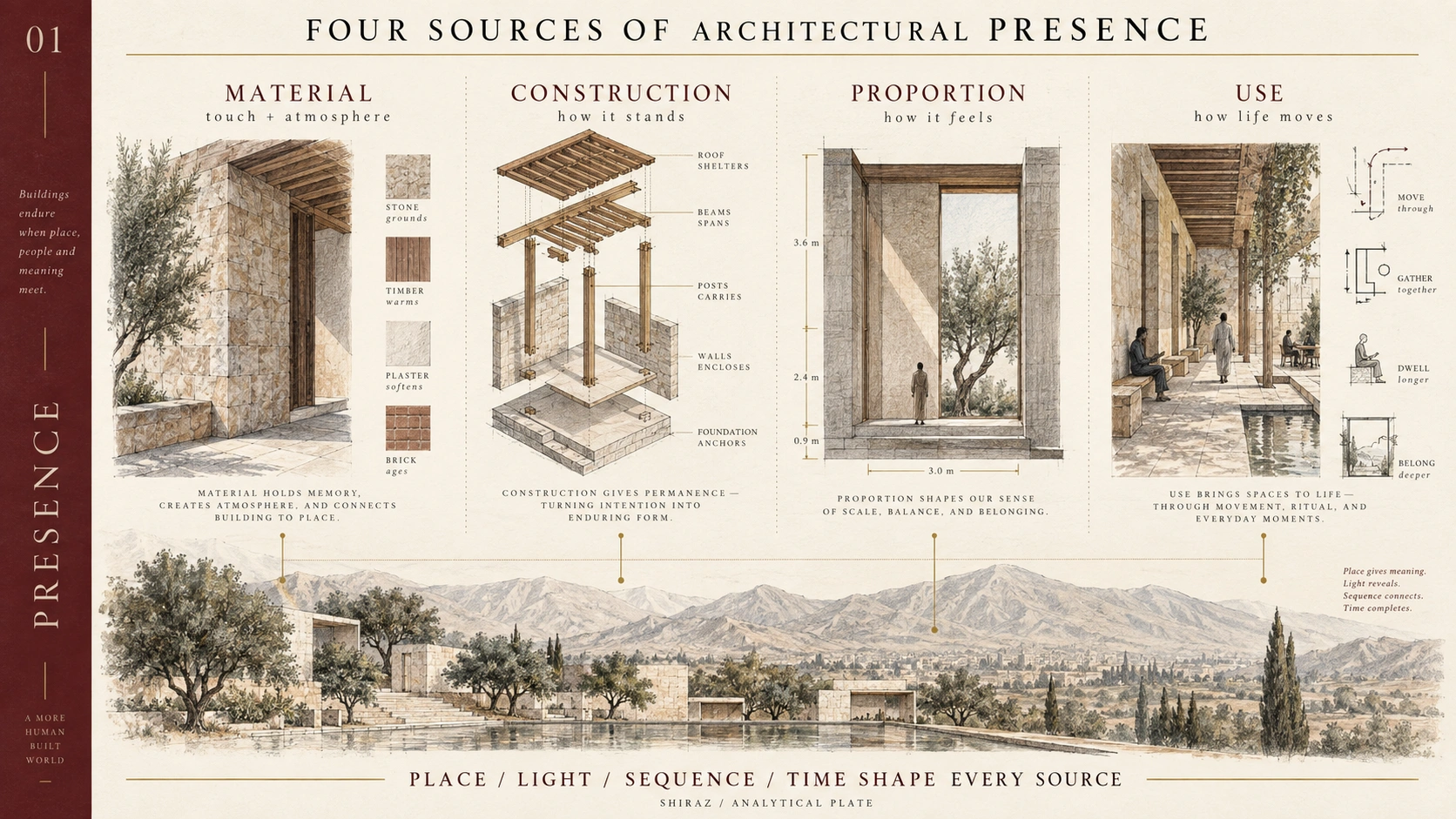
Four internal sources remain useful:
Material — what the building is made from.
Construction — how it stands and how its parts meet.
Proportion — how height, width, rhythm, scale and enclosure are organised.
Use — how people move, touch, sit, open, close and inhabit.
But these sources do not work in isolation.
Place shapes them. Climate, ground, vegetation, neighbouring buildings, local craft and planning constraints influence what is appropriate.
Light reveals them. The same wall can feel heavy, soft, flat or deep depending on how light reaches it.
Sequence exposes them over time. Character is often understood through approach, threshold, turn and release rather than one frontal view.
Time tests them. Ageing, maintenance, adaptation and repeated use reveal whether the original coherence can endure.
Presence is strongest when these conditions support one another instead of competing for attention.
01 · Dominus Winery — character through material, climate and ground
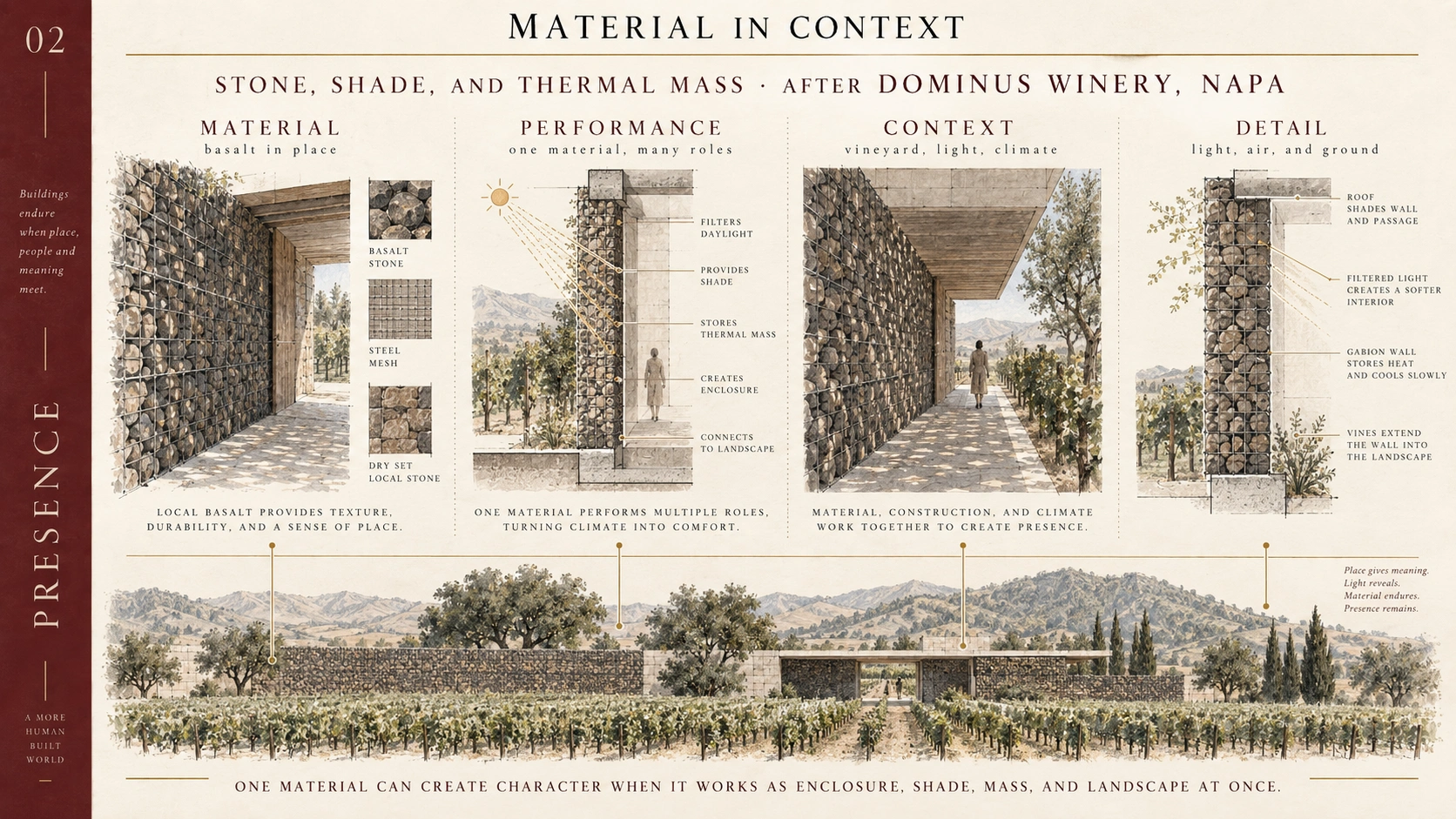
At Dominus Winery in Napa Valley, Herzog & de Meuron placed gabions filled with local basalt in front of the building envelope.
The stone is not simply an image. It forms a porous outer layer that connects facade, shade, thermal moderation and landscape. The material belongs to the ground, but its architectural power comes from what it does.
The Presence of Dominus does not come from “using stone”. It comes from the agreement between material, environmental performance, construction and place.
This is close to terroir in wine: character shaped by a particular ground and climate. In architecture, however, terroir is not achieved by selecting a local material and stopping there. The material must participate in the logic of the building.
For a home: ask what each important material contributes beyond appearance. If its only role is visual novelty, it may add surface character without creating Presence.
02 · Church of the Light — character through proportion, darkness and one opening
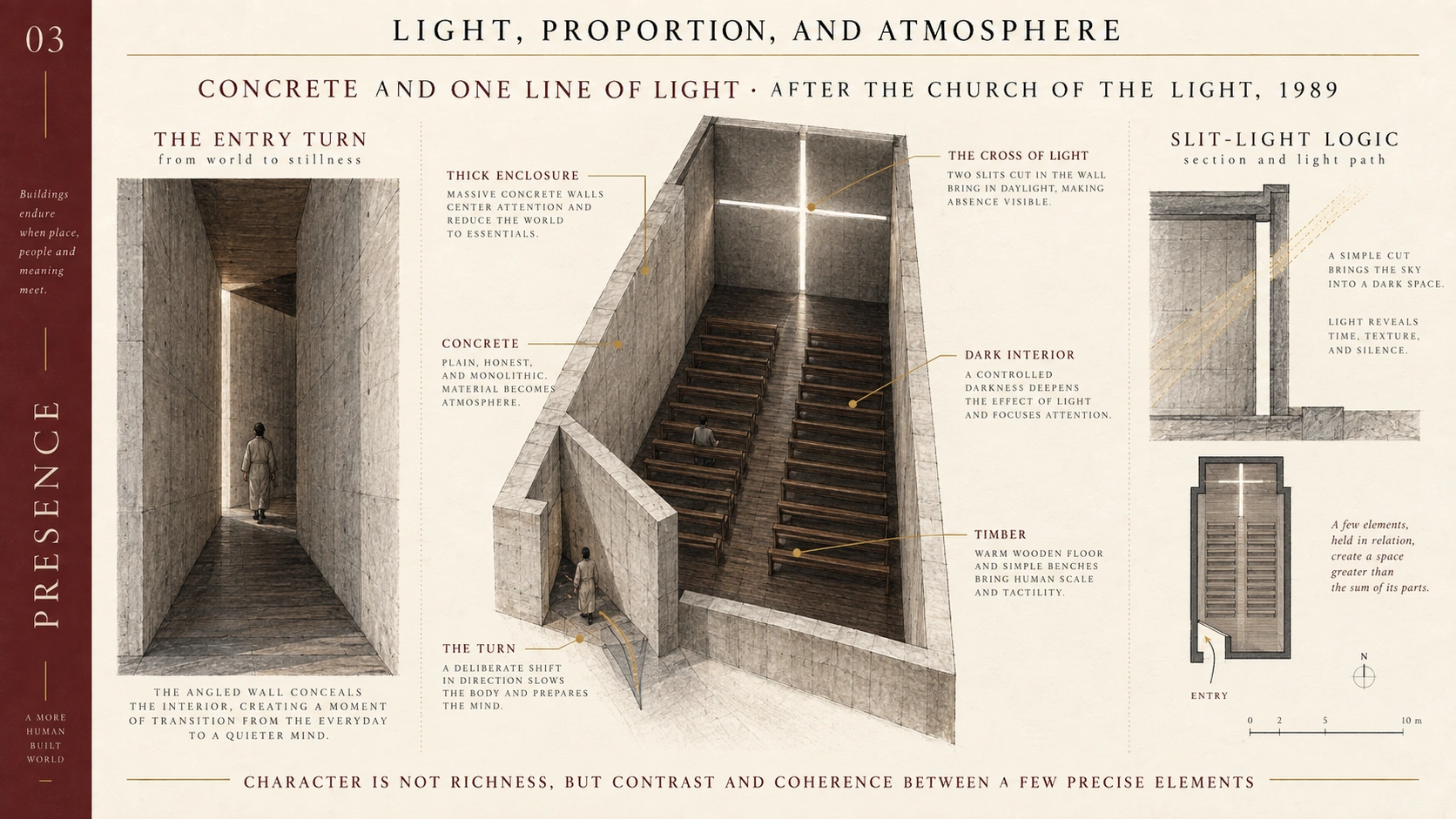
Tadao Ando’s Church of the Light uses very little: concrete enclosure, dark timber seating and a cruciform opening.
Yet the room has unmistakable Presence.
Its identity comes from relationships: weight against light, enclosure against opening, rough use against precise geometry. A separate wall redirects the approach before the main room is revealed, so the architecture is not understood in one glance.
Concrete alone does not create this character. The same material could produce an anonymous room.
Here, proportion, construction, darkness, light and movement reinforce one another.
For residential design, the lesson is simple: architectural character often comes from fewer decisions, made more precisely.
03 · Marie Short House — character through behaviour
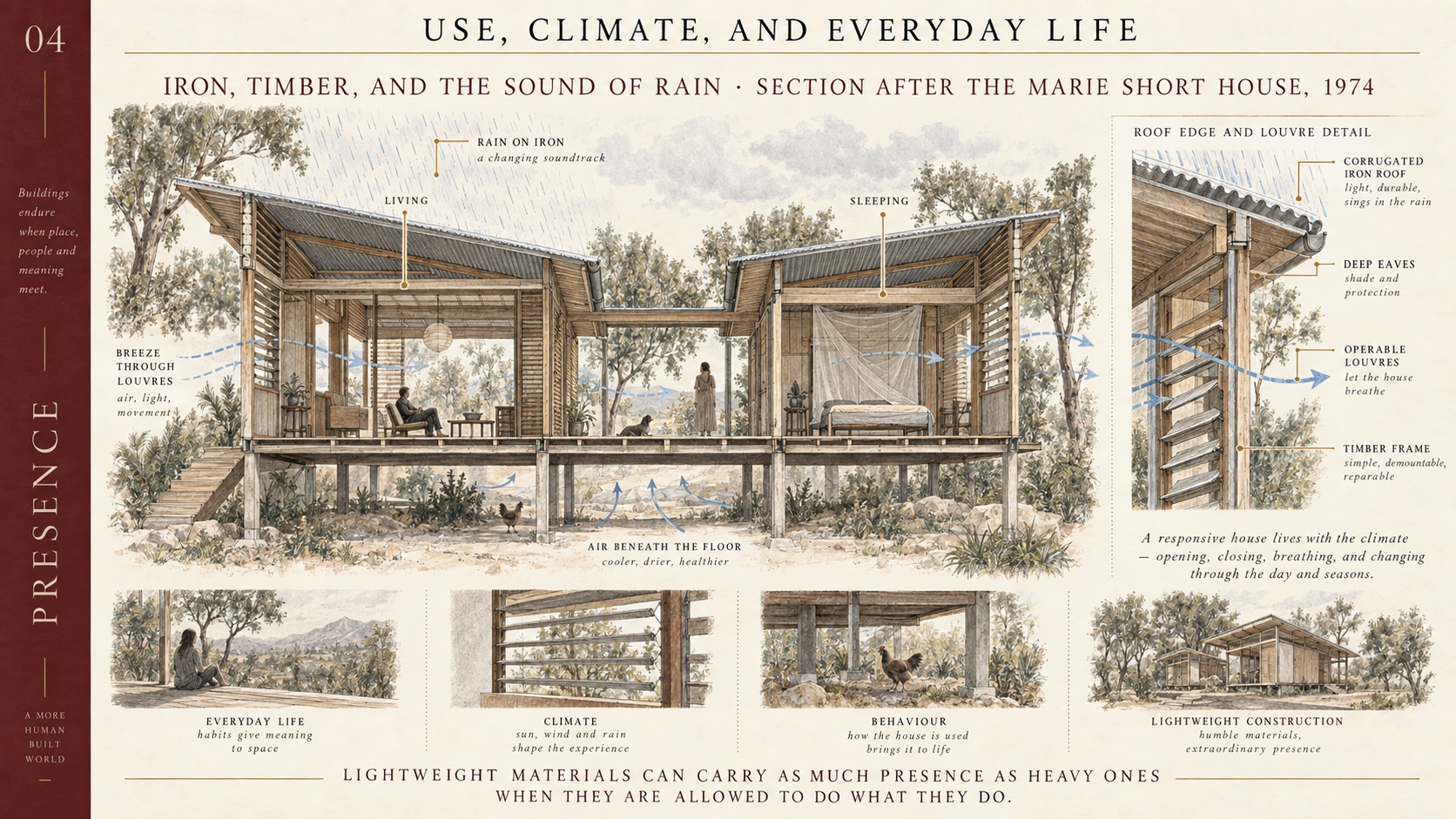
Glenn Murcutt’s Marie Short House offers a very different kind of Presence.
The house is lightweight. Timber frames repeat. Corrugated metal roofs respond audibly to rain. Louvres move. Air passes beneath the floor. The building changes with weather and occupation.
Its character is not monumental and it is not located in one expensive surface.
It is produced by the way the house behaves.
That matters because Presence should not be confused with visual weight. A lightweight building can have as much Presence as masonry when material, assembly, climate and use form a coherent system.
Presence is not weight. It is recognisable coherence.
Presence is not spectacle
A quiet or modest-budget house can have powerful Presence. It does not require rare stone, exposed structure everywhere, oversized gestures or a “feature” in every room. Too many competing gestures often weaken it.
The aim is not to make every element demand attention, but to make the important decisions belong to the same architectural idea. A deep reveal, a carefully proportioned opening or a well-resolved junction can give a house more identity than an expensive finish.
Material still matters — but as part of a whole
Material is one of the strongest ways Presence becomes tangible because it is where the body meets architecture. But material and finish are not the same thing: material is the substance — brick, timber, concrete, stone, metal or glass — while finish is its visible treatment.
There is no rule that “raw” is more honest. Material honesty means appearance, performance and construction agree.
For each major material, test three things:
Performance — exposure, fire, maintenance, acoustics, thermal role. Expression — texture, scale, colour, ageing and atmosphere. Construction — joints, edges, fixings and transitions.
What Presence might mean in a Canberra home
Canberra does not need a signature SHIRAZ material palette.
Presence should emerge from the particular house.
A north-facing living room may gain character from winter light reaching a masonry wall. A sheltered threshold may be defined by a deep brick reveal. Timber may appear where hands, feet and shoulders meet the building. Metal may make a lightweight roof that changes the acoustic experience of rain. They make your custom home.
The key is not the individual material. It is whether site, climate, proportion, light, construction and everyday use converge into one recognisable identity.
This is why two houses using the same brick can have completely different Presence.
How a house develops Presence
Start with place. Let climate, ground, vegetation, neighbouring character and available craft shape the first decisions.
Limit, then repeat. A small family of materials and details becomes more recognisable when used consistently.
Design the joint. The meeting between brick and timber, wall and roof, or stone and plaster often reveals more about architectural quality than the surfaces themselves.
Match scale to use. What works on a public facade may feel harsh where a hand or shoulder meets it every day.
Design light with form. Ask not only where windows go, but how light will reveal depth, texture and proportion at different times.
Draw how it ages. Fading, patina, movement, replacement and maintenance should be considered from the beginning.
Keep performance visible where useful. Shading, ventilation, structure and weather protection can contribute to character instead of being concealed behind it.
Presence within the four Shiraz qualities
The four qualities overlap, but they do different work.
Depth asks: How does the architecture reveal itself?
Presence asks: What makes this place recognisably itself?
Balance asks: How does it negotiate body, building and land?
Resonance asks: What remains after the experience?
Presence sits between discovery and memory.
We first encounter architecture through movement. We gradually recognise its character. We understand how it belongs. Then, over time, parts of the experience return to us.
Presence gives character a perceptible form
Character describes what a place is.
Presence describes what it is like to encounter that character.
A building develops Presence when its materials, construction, proportions, light, use and relationship to place reinforce one another strongly enough to become recognisably itself.
Some buildings are simply seen.
Others are gradually recognised — by the eye, but also through touch, sound, movement, weather and repeated use.
Within Discover the Taste of Architecture, Presence is the point at which architectural character becomes perceptible.
Frequently asked questions
What is architectural Presence? The recognisable character that emerges when the main decisions of a building reinforce one another rather than operate as isolated features.
Is Presence the same as architectural character? Not exactly. Character describes the qualities a place possesses; Presence describes how those qualities are perceived when the place is encountered.
Does a house need expensive materials to have Presence? No. Coherence, proportion, light, construction and use matter more than material price.
What gives a Canberra home Presence? There is no universal formula. It can emerge when climate, site, light, material, proportion, construction and daily life are resolved as one architectural idea.