Subdivision vs Unit Titling in Canberra: Complete Guide
Block subdivision and unit titling both allow Canberra properties to be sold separately, but they create very different ownership structures. This guide compares separate Crown leases, unit titles, common property, shared services, owners corporations and
Jul 30, 2026
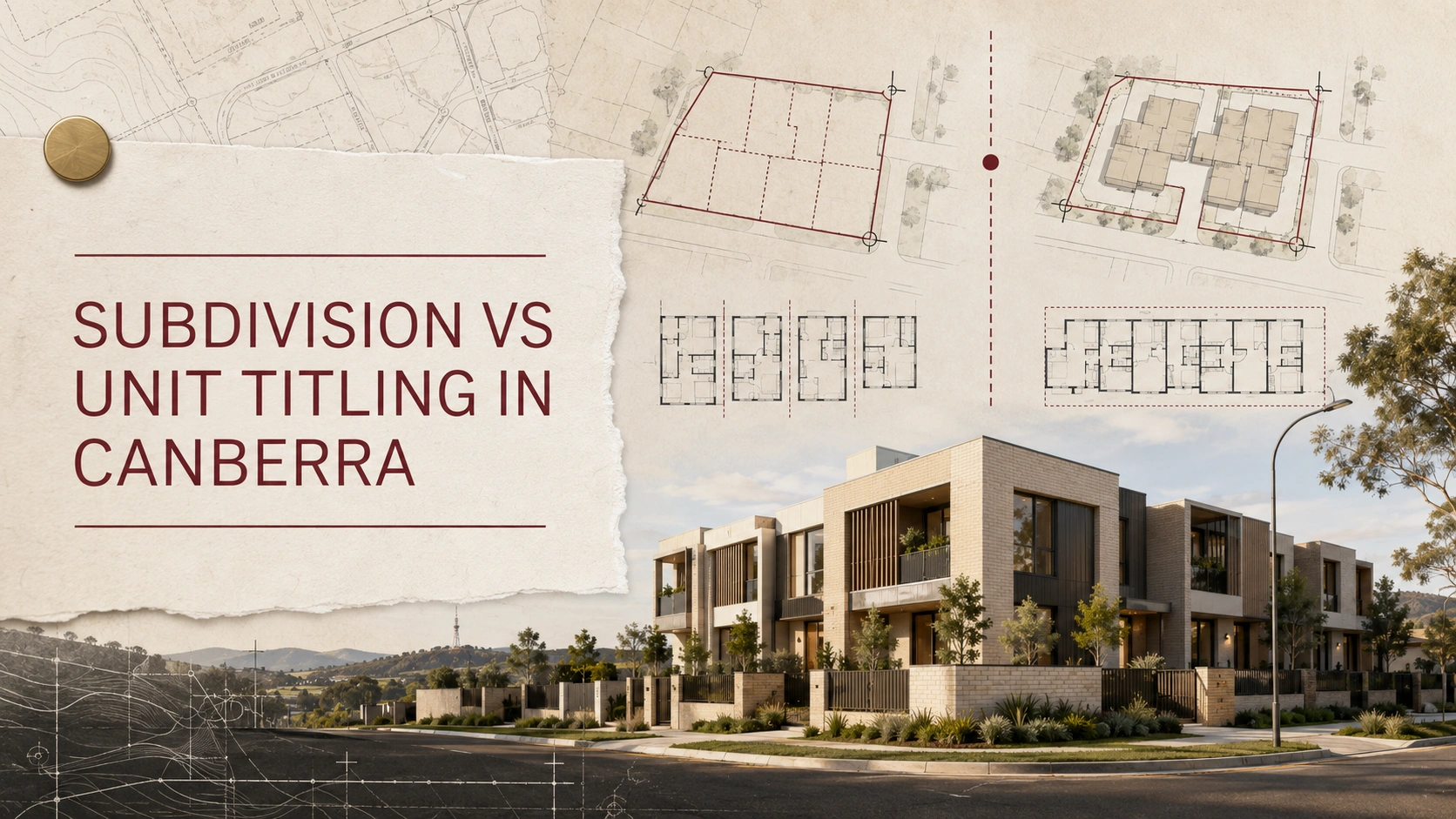
Subdivision vs Unit Titling in Canberra: Which Title Structure Is Right?
In short: Block subdivision creates separate blocks with separate Crown leases. Unit titling creates individually owned units within a units plan registered over one Crown lease, with common property and an owners corporation. Block subdivision may occur before dwellings are built if each block can support compliant development. Unit titling generally occurs after approved dwellings are constructed and have certificates of occupancy and use.
For a Canberra townhouse, dual-occupancy or apartment project, title strategy affects site planning, driveways, services, finance, maintenance and timing. It should be considered before concept design—not after construction.
What is block subdivision in Canberra?
Block subdivision divides one leased block into two or more blocks. Each receives a separate Crown lease and can be transferred independently.
ACT Planning allows block subdivision in residential RZ1 to RZ5 zones, subject to the Territory Plan and Subdivision Technical Specifications. A subdivision-design DA must show that each block can accommodate compliant development.
New blocks may be created before dwellings are built. An undeveloped lease can include covenants requiring construction to commence and finish within prescribed periods, and Ministerial consent may be needed for transfer.
What is unit titling in Canberra?
Unit titling divides an approved development into separately owned units under the Unit Titles Act 2001. The units plan is registered over the underlying Crown lease, and owners hold their unit together with an interest in common property.
ACT unit plans use either Class A units, bounded by floors, walls and ceilings and typical for apartments, or Class B units with a surveyed ground footprint, typical for townhouses.
Unit titling generally occurs after all dwellings are lawfully constructed and have certificates of occupancy and use. The unit-title application is a separate process under the Unit Titles Act, not part of the Planning Act DA.
What is the main difference?
Block subdivision: separate land parcels and separate Crown leases.
Unit titling: separately owned units within one units-plan structure, generally with common property.
Physical appearance does not decide the title. Attached townhouses may sit on separate leases, while detached dwellings may form one unit-title scheme.
Both allow separate sale after registration. Separate leases generally provide greater independence; unit owners share common-property responsibility.
What is common property?
Common property is shared land, infrastructure or building fabric outside individual units. It may include driveways, visitor parking, landscaping, waste areas, lobbies, lifts, roofs, structure or services.
Clear unit boundaries determine maintenance and insurance responsibility. Block subdivision usually avoids owners-corporation property, but shared infrastructure may still need easements and agreements.
What does an owners corporation do?
Every unit owner joins the owners corporation, which manages common-property insurance, maintenance, budgets, levies, records and contracts. It exists even for two townhouses.
How are shared driveways and services treated?
Under unit title, a shared driveway can be common property managed by the owners corporation. Under block subdivision, a driveway crossing separate leases may require reciprocal access easements and maintenance arrangements.
The design should resolve vehicles, pedestrians, waste, drainage, utilities and repairs. A geometrically workable driveway can still be legally problematic.
Each subdivided block generally needs separate servicing and metering. Unit-title schemes require metering but may share electricity, sewer and stormwater ties. Shared infrastructure must remain accessible.
Can I subdivide before building?
Block subdivision may be approved before dwellings are built if the DA demonstrates that each block can support compliant development. New leases may then include development covenants.
Unit titles generally cannot be created before construction. The approved multi-unit housing must be built and have certificates of occupancy and use before approval under the Unit Titles Act.
This difference can materially affect finance, staging and sales.
Do I need to vary the Crown lease?
Possibly. The lease must support the proposed number of dwellings and title pathway.
If it is limited to one dwelling, it may require variation before block subdivision or unit titling. A residential-purpose lease that does not specify a dwelling number may need variation to specify the number before unit titling.
Lease variation can attract LVC. Block subdivision has a codified subdivision charge, while variations increasing or specifying dwelling numbers use the relevant schedules of the current LVC determination.
Eligible RZ1 and RZ2 missing-middle projects may receive the temporary 2026 LVC reduction if all deferral, approval and completion conditions are met.
What must block subdivision address?
The subdivision DA must address:
block dimensions and compliant dwelling capacity
frontage, legal access and solar orientation
trees, easements and service corridors
stormwater, utilities, waste and vehicles.
Current guidance suggests 350 square metres for new RZ1 blocks created by subdividing one established block. This does not mean every 700-square-metre site works: frontage, trees, access and building envelopes may prevent it.
What is required for unit titling?
Unit titling requires:
DA supporting the multi-unit development
a lease specifying the authorised dwellings
completed lawful dwellings with occupancy certificates
generally at least 50 years remaining on the Crown lease
documented boundaries, common property and entitlements
required metering and servicing.
At least two units and common property are required. Current guidance permits dual occupancy on a standard RZ1 block from 600 square metres, subject to all other controls.
Townhouse example: separate leases or unit titles?
Consider three townhouses sharing one driveway.
With block subdivision, each townhouse sits on its own Crown lease. The design must create compliant blocks, protected access and appropriate servicing. The driveway may require easements and a maintenance agreement.
With unit titling, each townhouse can become a Class B unit. The driveway and landscaping may remain common property managed by the owners corporation.
The choice depends on geometry, services, market expectations, cost and management complexity.
How are apartments titled?
Apartments are normally Class A unit titles because vertically stacked dwellings depend on shared structure, circulation and services. Lobbies, lifts, fire stairs, roofs and central services generally become common property.
Which option is faster?
Block subdivision requires a DA, survey, services, LVC, deposited plans and registration, but may allow titles before completion.
Unit titling follows DA, BA, construction and occupancy certification; its separate application and registration occur later.
Unit titles are later, while block subdivision can involve more complex early planning and services. Program either pathway from project commencement.
How does title strategy affect design?
Title strategy influences boundaries, setbacks, access, services, private open space, fire separation, parking and staging. A late change can require redesign, easements, service relocation and DA amendments.
What should I check before choosing?
Crown lease and authorised dwellings
zone, subdivision policy and buildable envelope
frontage, trees, slope and easements
utilities, driveway, waste and emergency access
LVC, surveying and registration costs
owners-corporation and maintenance implications
construction, finance and sales program.
A preliminary layout should test development yield and title practicality together.
Frequently asked questions
Does unit titling create separate Crown leases?
No. A units plan is registered over the Crown lease. Each unit receives a unit title and an interest in common property.
Can townhouses have separate Crown leases?
Yes, where block subdivision is approved and each block satisfies planning, access, servicing and lease requirements.
Do two unit-titled townhouses need an owners corporation?
Yes. The unit owners form the owners corporation responsible for the units plan and common property.
Can a secondary residence be separately titled?
No. Current ACT guidance states that a block containing a primary dwelling and secondary residence cannot be subdivided under the Planning Act or Unit Titles Act.
Which option has lower ongoing costs?
Separate leases may avoid owners-corporation levies but can still involve shared-access or service obligations. Unit-title costs depend on common property, insurance and maintenance.
What do these planning changes mean for your property?
Explore your block’s realistic development potential before committing to design. Check My Block’s Potential
Choose the title structure before finalising the design
Subdivision and unit titling are not administrative choices to postpone. They affect whether a layout is legally, technically and financially workable.
Shiraz Atelier assists Canberra owners and developers with zoning and Crown lease assessments, subdivision and unit-title feasibility, townhouse and multi-unit design, DA documentation and consultant coordination.
The objective is to align architecture, title structure, services and approval sequence before expensive commitments are made.
This is general information, not legal, surveying, planning or financial advice. Confirm current requirements with ACT Planning, a registered surveyor and qualified advisers.