Change of Use in Canberra: DA, BA and Crown Lease Guide
Changing an office, warehouse, shop or residence to a new use can trigger several approval requirements in Canberra. This guide explains when you may need a development application, Crown lease variation, building approval and a new certificate of occupan
Jul 30, 2026
Change of Use in Canberra: Do You Need a DA, Building Approval or Crown Lease Variation?
Changing an office, warehouse, shop or residence to a new use can trigger several separate approvals in Canberra. You may need a development application (DA), Crown lease variation, building approval (BA), and a new certificate of occupancy or use—even when the fitout appears minor.
In short
A use permitted by the Territory Plan may still be prohibited by the Crown lease. A planning-approved use may also require building upgrades before it can legally operate.
Before signing a lease, purchasing a property or committing to a fitout, confirm:
whether the activity is permitted in the Territory Plan zone;
whether the Crown lease authorises it;
whether existing approvals and the certificate of occupancy or use support it; and
whether the use changes the building’s NCC classification or compliance requirements.
A cheap lease can become an expensive conversion if these questions are left until after commitment.
What is a change of use in Canberra?
A change of use occurs when land or a building will be used differently from its existing lawful or approved use. It may change the planning use, Crown lease purpose, NCC classification or operational impact.
The business name does not determine the pathway. A “studio,” “wellness centre” or “learning space” could be assessed as an office, health facility, indoor recreation facility or place of assembly depending on what actually occurs there.
Do I need a DA for a change of use?
A DA may be required when the proposed use is not authorised, the Crown lease must be varied, or associated work does not satisfy every applicable exempt-development criterion.
Check:
Is the use permitted in the Territory Plan zone?
Does the Crown lease authorise it?
Is the existing approval limited to another use?
Does the current certificate of occupancy or use support it?
Will the fitout, signage, access, parking or external work require approval?
Does an internal commercial fitout need a DA?
“The work is internal” does not automatically mean “no DA.” An internal alteration may be DA-exempt only when all relevant ACT criteria are satisfied. This includes no change to the NCC building classification and, for a non-residential building, no increase in gross floor area. The proposal must also comply with applicable general criteria, including the Crown lease.
DA exemption does not remove requirements under other laws. BA and other regulatory approvals may still apply.
Planning use and NCC classification are different
Planning use asks whether the activity is authorised and appropriate on the land. It can involve zoning, the Crown lease, traffic, parking, noise and amenity.
NCC classification determines the building-safety and performance requirements based on occupation. It affects fire safety, exits, accessibility, toilets, ventilation and essential services.
Common classifications include:
Class 5: office or professional premises;
Class 6: shop, café, restaurant or service premises;
Class 7b: storage building or warehouse;
Class 8: factory, workshop or process building; and
Class 9b: assembly building, including many training, recreation and community uses.
Do I need building approval?
BA is likely when a fitout includes regulated building work or the building classification changes. Early assessment by a licensed building surveyor acting as building certifier is important.
A change can trigger investigation of occupant numbers, exits, travel distances, fire safety, accessibility, toilets, ventilation, structural loads, energy efficiency and necessary upgrades to the existing building.
Even with little physical work, the premises may not comply with the proposed use or class.
DA versus BA: which comes first?
Where a DA is required, it generally must be granted before the building certifier can issue BA. Preliminary NCC review should still begin early because required upgrades may affect design, cost and feasibility.
A typical pathway is:
Confirm the lawful use, NCC class, approvals and occupancy or use certificate.
Review the Territory Plan, district policy, Crown lease and site constraints.
Obtain preliminary planning and building-certification advice.
Lodge any required DA or Crown lease variation.
Complete the technical fitout and compliance documentation.
Obtain BA through the appointed building certifier.
Complete the work and inspections.
Obtain the required certificate of occupancy or use before operating.
When is a Crown lease variation required?
Canberra is a leasehold jurisdiction. The Crown lease states the purposes for which land may be used and can be narrower than the Territory Plan zone.
For example, a zone may contemplate community uses while the lease authorises offices only. A DA involving lease variation may be required. A variation can also attract a Lease Variation Charge (LVC), affecting cost and timing.
Common change-of-use examples
Office to training centre
An office is commonly Class 5, while a training centre may be Class 9b. The change can affect exits, accessibility, toilets, fire safety and parking.
Warehouse to gym
A Class 7b warehouse may become a Class 9b gym, affecting loading, ventilation, access, egress, fire safety, noise and parking.
Shop to restaurant
Both may be Class 6, but a restaurant may still require exhaust, trade-waste arrangements, additional toilets, fire work and waste storage.
Other common examples include a residence becoming a medical practice and commercial premises becoming a childcare centre. Accessibility, parking, amenity, fire safety and separate licensing may need assessment.
What costs can a change of use trigger?
The rent and visible fitout are only part of the project cost. Potential cost triggers include:
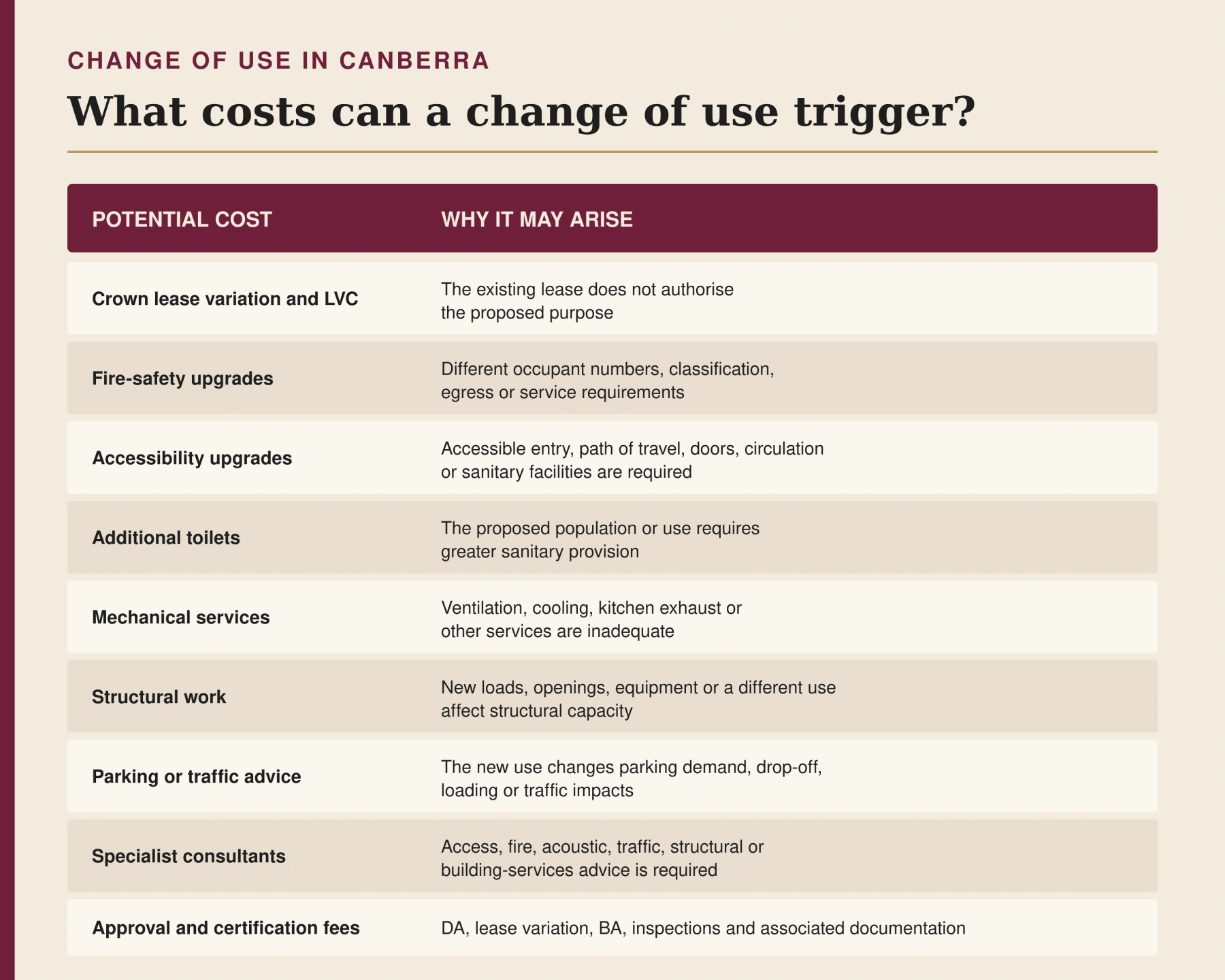
This list is not exhaustive. A focused feasibility review is intended to identify the major project-specific risks before detailed design and construction expenditure begins.
How long does approval take?
There is no standard timeframe. Timing depends on the approval pathway, information requests, NCC upgrades, consultant coordination and certifier availability.
Allow time for due diligence before setting an opening date or agreeing to rent commencement. Base the program on the property’s actual pathway, not a generic estimate.
Can fitout work proceed while the DA is assessed?
Starting regulated work before approval creates significant risk. Design can continue during assessment, but construction should wait until the pathway is confirmed and approvals are in place.
Protect yourself before signing the lease
Before entering an unconditional lease, obtain planning, Crown lease and building-compliance advice. Ask a solicitor whether the lease should address:
satisfactory due diligence and required approvals;
landlord consent for applications and building work;
responsibility for upgrades and consultant costs;
access for investigations;
approval periods and termination rights;
rent commencement and fitout periods; and
end-of-lease reinstatement.
Obtain advice from a solicitor experienced in ACT commercial leasing.
Pre-lease checklist
Request and review:
the Crown lease and variations;
current certificate of occupancy or use;
previous DA decisions and endorsed plans;
BA and completion records;
current NCC classification;
fire-safety, accessibility and toilet information;
parking, loading, waste and bicycle arrangements;
structural and building-services capacity;
asbestos information for older premises;
signage and external-work requirements; and
licences needed for the business.
Frequently asked questions
Is a new tenant automatically a change of use?
No. If the activity, approved use and NCC class remain unchanged, a new tenant may not create a change of use. Fitout, signage or operational changes may still require approval.
Can my business operate if the zone permits it?
Not necessarily. The Crown lease, existing approvals, certificate of occupancy or use and building compliance must also support the activity.
Does Class 5 to Class 9b require approval?
It commonly requires planning and building assessment because additional life-safety, accessibility and sanitary requirements may apply.
Who confirms whether the premises can be used?
An architect or planning adviser investigates zoning, approvals and the Crown lease. A licensed building surveyor assesses NCC classification and BA. Other specialists may also be required.
Start with a change-of-use feasibility review
A successful change of use aligns the business model, planning permission, Crown lease and building compliance.
Shiraz Atelier assists Canberra owners, tenants and organisations with pre-lease assessments, change-of-use feasibility, commercial fitout design, DA documentation and coordination with building certifiers and specialist consultants.
Considering a Canberra property for a training centre, clinic, gym, restaurant, childcare facility or another new use? Arrange a pre-lease change-of-use review before committing.
This article provides general information and is not legal, planning or building-certification advice. Requirements depend on the property, proposed activity and legislation applying at the relevant time.
What do these planning changes mean for your property?
Explore your block’s realistic development potential before committing to design. Check My Block’s Potential
Official references
· ACT Planning — Check if you need a DA
· ACT Planning — Building approvals